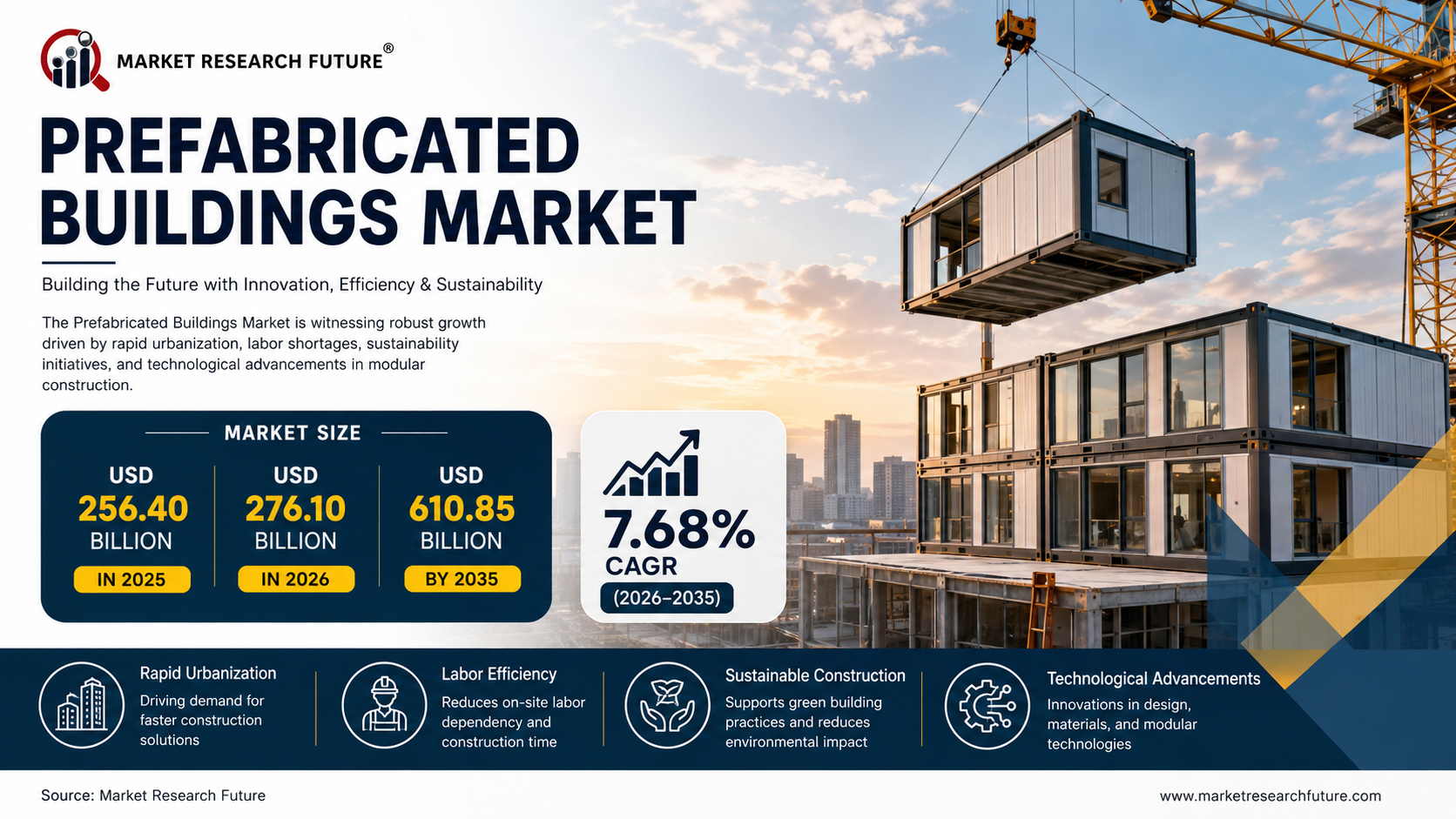
Prefabricated Buildings Market to Grow from USD 276.10 Billion in 2026 to USD 610.85 Billion by 2035 at 7.68% CAGR
North America led the Prefabricated Buildings Market with 35.4% of 2025 revenue. GA, UNITED STATES, September 2, 2026

Press Release Disclaimer: This is a press release distributed through the XPR Media network. It has not been independently verified by our newsroom.
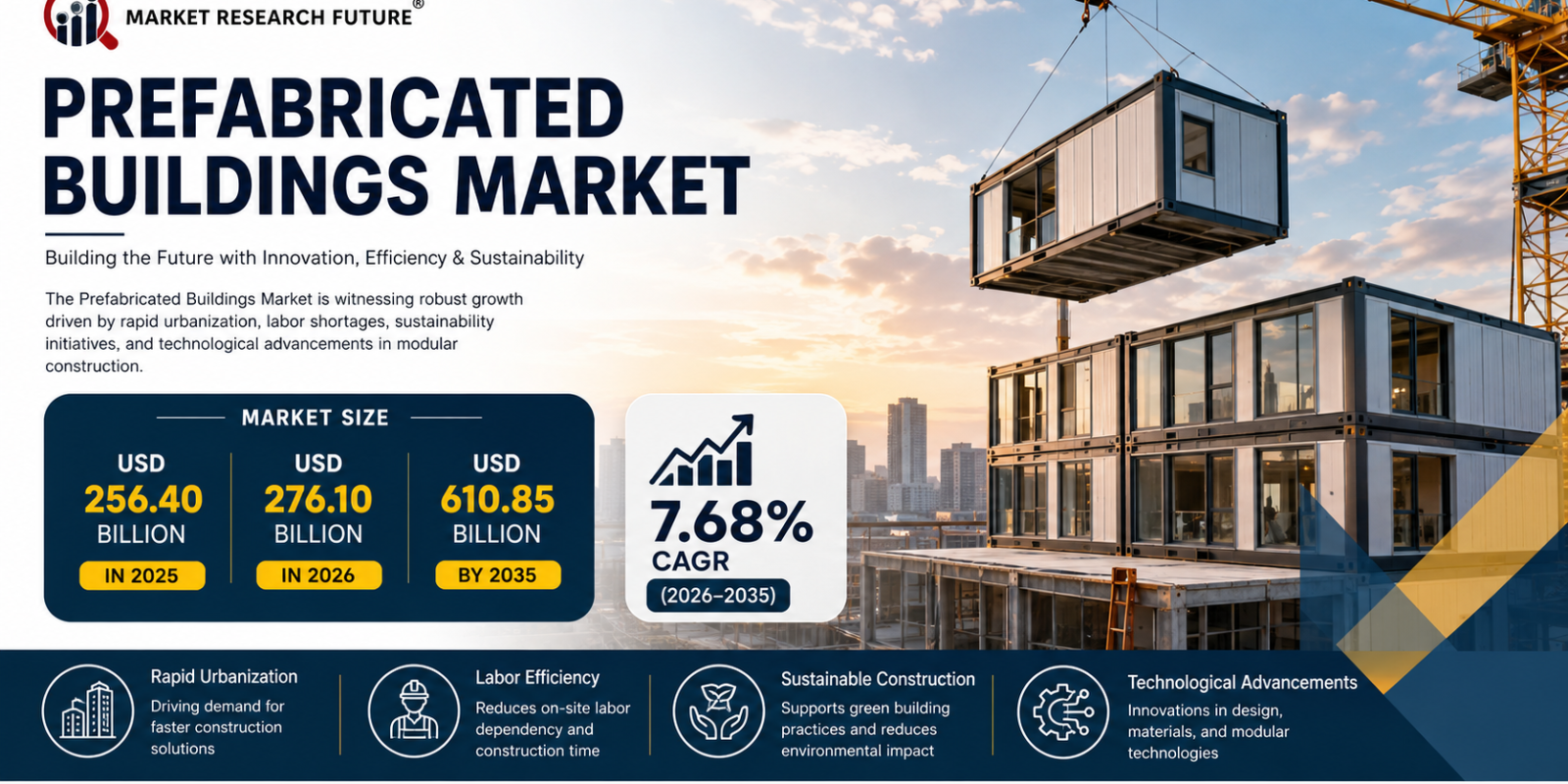

North America led the Prefabricated Buildings Market with 35.4% of 2025 revenue.
GA, UNITED STATES, September 2, 2026 /EINPresswire.com/ — The Prefabricated Buildings Market is expanding as the construction industry moves toward factory-based production, standardized building systems, and technology-driven project delivery. Prefabricated buildings allow components, panels, modules, and sub-assemblies to be manufactured in controlled environments before being transported and installed at construction sites. This approach can reduce construction timelines, improve quality consistency, and address labor shortages.
According to Market Research Future, the global Prefabricated Buildings Market reached USD 256.40 billion in 2025 and is expected to reach USD 276.10 billion in 2026. The market is projected to grow to USD 610.85 billion by 2035, registering a 7.68% CAGR during 2026–2035.
Skilled Labor Shortage Accelerates Factory-Based Construction
A shortage of skilled construction workers is becoming an important driver for prefabricated building adoption. Conventional construction requires large numbers of skilled workers to perform activities directly at project sites, while factory production can shift many tasks into controlled manufacturing facilities.
Factory-based production allows companies to organize workers into specialized production lines and integrate automated equipment. This can improve productivity and reduce dependence on site-based labor.
The labor challenge is particularly relevant in North America and Europe, where construction companies face workforce shortages and increasing wage costs. Prefabrication provides developers with an opportunity to improve project predictability while managing labor constraints.
Housing Deficits Create Significant Opportunities
Housing shortages across emerging and developed markets are creating substantial opportunities for prefabricated building manufacturers. Governments are increasingly implementing housing programs that require rapid construction of large numbers of residential units.
Residential applications accounted for 61.6% of market demand in 2025, making housing the largest application category. Government-supported housing programs in markets such as China, India, and Brazil are contributing to demand for factory-produced building systems.
Prefabrication can support large-scale housing programs because standardized designs can be produced repeatedly while maintaining consistent quality. Developers can also reduce exposure to weather-related construction delays by completing much of the building process inside factories.
Download Report Sample Copy with TOC: https://www.marketresearchfuture.com/sample_request/5171
Concrete Remains the Leading Material
Concrete accounted for approximately 43.4% of Prefabricated Buildings Market revenue in 2025, making it the leading material category. Concrete prefabrication is widely used for structural systems, facades, podiums, and other building components.
The established precast-concrete manufacturing infrastructure in mature construction markets supports continued demand.
Steel is another important material, generating approximately USD 62.10 billion in 2025. Steel-framed systems are particularly useful for commercial and industrial structures because of their strength-to-weight characteristics and ability to support large spans.
Timber, including cross-laminated timber, represents a faster-growing material category. It is projected to expand at an 8.52% CAGR through 2035, supported by increasing attention to embodied carbon and sustainable construction.
Commercial Construction Creates New Growth Channels
Although residential buildings currently dominate the market, commercial applications are expanding rapidly. Commercial construction is projected to grow at an 8.65% CAGR from 2026 to 2035, supported by data centers, logistics facilities, hospitality projects, and other commercial developments.
The ability to shorten construction schedules is particularly valuable for commercial properties because earlier completion can allow businesses to begin generating revenue sooner.
Data centers are becoming a particularly attractive opportunity. Hyperscale operators require standardized buildings, electrical systems, cooling infrastructure, and other components that can benefit from factory production.
Modular Systems Lead Product Demand
By product type, modular or volumetric systems accounted for approximately 51.1% of market share in 2025. Volumetric construction transfers a substantial portion of the building process from the construction site to the factory.
Complete modules can include structural elements, walls, floors, ceilings, electrical systems, plumbing, and interior finishes before they reach the project site.
Panelized systems remain important where transportation constraints make full volumetric modules less economical. Panels can be transported more efficiently and assembled at the final location.
Hybrid and pod systems are also gaining momentum and are projected to grow at an 8.90% CAGR through 2035. Bathroom pods, mechanical rooms, and prefabricated service components provide contractors with a lower-risk way to adopt prefabrication without transitioning completely to volumetric construction.
Automation Improves Manufacturing Efficiency
Automation is transforming prefabricated building production. Robotic welding, automated framing, digital measurement systems, and computer-controlled manufacturing equipment can improve production accuracy and reduce repetitive manual work.
Building Information Modeling is also becoming increasingly important. BIM enables designers, engineers, manufacturers, and contractors to coordinate building components digitally before production begins.
Digital twins can further improve quality control by connecting physical production processes with digital models. Manufacturers can use sensor data to identify dimensional deviations and production issues before modules reach construction sites.
As automation becomes more affordable, larger manufacturers are expected to invest in highly integrated production facilities.
Embodied Carbon Influences Material Selection
Sustainability is becoming an increasingly important factor in prefabricated building design. Regulations surrounding embodied carbon are encouraging developers to evaluate the environmental impact of building materials throughout their lifecycles.
Factory production can help reduce material waste because manufacturing takes place in controlled environments with optimized cutting and assembly processes.
Timber systems are gaining attention because engineered wood products can provide structural performance while supporting lower-carbon construction strategies in suitable applications.
The growing use of whole-life carbon assessments is expected to influence material selection across Europe, North America, and other markets adopting stricter environmental standards.
Data Centers Support Specialized Prefabrication
The expansion of artificial intelligence, cloud computing, and digital services is creating strong demand for data centers. These facilities require rapid construction and highly standardized technical systems.
Prefabricated electrical rooms, cooling modules, structural shells, and other specialized components can be manufactured and tested before delivery.
This reduces the amount of complex installation required on-site and can help data-center developers meet aggressive construction schedules.
The trend also creates opportunities for specialized prefabrication companies that can meet strict technical, quality, and cleanroom requirements.
Affordable Housing Platforms Expand in Emerging Markets
Emerging economies represent significant long-term opportunities for prefabricated buildings. Rapid urbanization and housing deficits are increasing demand for affordable and rapidly deployable housing.
Localized manufacturing can be particularly advantageous because transporting complete modules over long distances can increase costs. Establishing production facilities near major demand centers can reduce transportation requirements while supporting local employment.
India and China are especially important markets because of their large populations and extensive urban-development programs. The Asia-Pacific region is projected to achieve the fastest regional growth, with a 9.34% CAGR through 2035.
Buy Now: https://www.marketresearchfuture.com/checkout?currency=one_user-USD&report_id=5171
Logistics Remains a Major Challenge
Despite its advantages, prefabrication has logistical limitations. Large volumetric modules can require specialized transportation, route planning, escorts, and permits.
Transportation distance can significantly affect the economics of modular construction. As a result, manufacturers are increasingly considering regional factory networks rather than relying on centralized plants serving very large geographic areas.
Panelized systems can offer an advantage in locations where transporting complete modules is difficult. Their compact form allows more efficient transportation while still providing many benefits associated with off-site manufacturing.
Plant Utilization Affects Profitability
Prefabricated construction requires substantial investment in manufacturing facilities, machinery, automation, engineering capabilities, and skilled personnel.
High factory utilization is therefore essential for maintaining competitive production costs. Manufacturers with insufficient order volumes may struggle to recover fixed production expenses.
This creates a competitive advantage for companies with large housing programs, long-term government contracts, data-center projects, or diversified customer portfolios.
As the market matures, successful manufacturers are likely to focus increasingly on securing repeat orders and maintaining predictable factory utilization.
North America Holds the Largest Regional Share
North America accounted for 35.4% of Prefabricated Buildings Market revenue in 2025, making it the largest regional market. The region benefits from multifamily housing demand, data-center development, labor shortages, and zoning reforms supporting factory-built construction.
The United States represents the dominant market within the region, while Canada is also seeing opportunities through housing initiatives.
Mexico is benefiting from industrial development and nearshoring, creating demand for warehouses, manufacturing facilities, and supporting structures.
Asia-Pacific Records the Fastest Growth
Asia-Pacific is expected to remain one of the most dynamic regions, growing at a 9.34% CAGR from 2026 to 2035. Urbanization, government housing programs, industrial development, and increasing factory automation are supporting regional expansion.
China represents a major market due to its large-scale urban redevelopment programs and established prefabrication capabilities.
India is another high-growth market, with its prefabricated buildings sector supported by housing requirements and increasing interest in modern construction technologies.
Japan provides a mature example of industrialized housing, with established manufacturers using highly standardized and technologically advanced production systems.
Report Summary: https://www.marketresearchfuture.com/reports/prefabricated-buildings-market-5171
Europe Focuses on Low-Carbon Prefabrication
Europe is another major market, generating approximately USD 71.53 billion in 2025. Environmental regulations, embodied-carbon requirements, renovation activity, and interest in engineered timber are supporting market development.
European developers are increasingly evaluating prefabricated systems as a way to improve energy efficiency and reduce construction waste.
Timber-based systems are particularly attractive in markets where carbon performance has become an important procurement criterion.
Retrofit and vertical-extension modules also represent emerging opportunities because prefabricated components can potentially add space to existing buildings without requiring extensive conventional construction.
Competitive Landscape
The Prefabricated Buildings Market includes major companies such as Sekisui House, Daiwa House Industry, Skanska, Clayton Homes, PEAB, Lendlease, Bouygues Construction, Laing O’Rourke, Element5, Forta PRO, and Champion Homes.
Competition is increasingly centered on manufacturing efficiency, automation, design capabilities, material innovation, sustainability, and the ability to deliver standardized systems at scale.
Companies are also developing specialized solutions for data centers, healthcare facilities, cleanrooms, housing, logistics buildings, and institutional projects.
Digital design libraries and pre-certified building systems could become increasingly valuable as customers seek shorter design and approval cycles.
Related Report
prefabricated glass block market https://www.marketresearchfuture.com/reports/prefabricated-glass-block-market-36852
prefabricated construction market https://www.marketresearchfuture.com/reports/prefabricated-construction-market-25798
modular prefabricated construction market https://www.marketresearchfuture.com/reports/modular-prefabricated-construction-market-28506
prefabricated steel market https://www.marketresearchfuture.com/reports/prefabricated-steel-market-25811
prefabricated kitchen pod market https://www.marketresearchfuture.com/reports/prefabricated-kitchen-pod-market-25213
scandinavia prefabricated housing market https://www.marketresearchfuture.com/reports/scandinavia-prefabricated-housing-market-25889
prefabricated construction product market https://www.marketresearchfuture.com/reports/prefabricated-construction-product-market-40282
Market Research Future
Market Research Future
+ +1 855-661-4441
email us here
Legal Disclaimer:
EIN Presswire provides this news content “as is” without warranty of any kind. We do not accept any responsibility or liability
for the accuracy, content, images, videos, licenses, completeness, legality, or reliability of the information contained in this
article. If you have any complaints or copyright issues related to this article, kindly contact the author above.

Media gallery