
Why Some Children Raise Their Hands and Others Stay Silent
Before children participate, persist or grow, they need evidence that they matter. Research connects this sense of

Press Release Disclaimer: This is a press release distributed through the XPR Media network. It has not been independently verified by our newsroom.

Before children participate, persist or grow, they need evidence that they matter. Research connects this sense of belonging to student success.
YOUNGSTOWN, OH, UNITED STATES, August 11, 2026 /EINPresswire.com/ — Do I matter here?
Children gather the answer from small interactions. Someone remembers what they said, notices when they withdraw, sees effort beyond the result or helps them recover from a mistake without feeling rejected.
Schools often approach achievement, motivation, behavior, confidence and resilience as separate outcomes. Research points deeper. Before students participate, persist or lead, they need evidence that they belong and that their contribution has value.
Feeling seen is not praise. It communicates two truths. You matter, and your choices matter. A child can be corrected without being erased.
Over time, that experience can form an internal sequence.
I am noticed. I belong here. My voice has value. My actions can affect what happens next. I have permission to try.
Opportunity is not the same as agency. Agency begins when a child believes participation is safe and meaningful.
What the Research Suggests
A 2025 systematic review synthesized 26 meta-analyses spanning more than 70 years and approximately 2.64 million students. Teacher-student relationships were significantly associated with achievement, motivation, engagement, belonging, behavior, self-control, emotional outcomes and well-being.
A separate meta-analysis of 82 studies linked school belonging with motivational, social-emotional, behavioral and academic functioning.
No single factor determines a child’s future. But the evidence supports a chain educators recognize.
Recognition → Belonging → Participation → Confidence, resilience and agency
Recognition strengthens belonging. Belonging makes participation safer. Participation creates opportunities to practice, contribute, recover and grow. Repeated action builds confidence, resilience and agency.
The reverse can reinforce itself. A student who feels invisible, misread or reduced to a score may decide silence is safer. Why risk an answer if experience suggests it will not matter?
From Being Known to Becoming One Among Many
In a secure home environment, a child may be intimately known. Their expressions, worries, curiosities and needs may be recognized before they are spoken. But not every child experiences that foundation consistently. For some children, school confirms that they matter. For others, it may be the first place capable of establishing it.
Then school begins. The circle grows and attention is divided. A child moves from being intimately known, or hoping to become known, to becoming one learner among many.
Students collect new evidence. People like me have a place here, or I must become someone else to belong. My ideas are worth sharing, or it is safer to disappear. Mistakes help me learn, or mistakes expose what is wrong with me.
Observation is sometimes described as passive, but attention is an interaction. Being watched does not transform a child. Being known can help a child begin to transform themselves.
A New Standard for Education Technology
As schools adopt powerful technology, evaluation should extend beyond content and efficiency. A more human question is emerging.
Does the technology simply present the lesson, or help every child see themselves as part of it?
Heroes Made is inviting elementary school and district leaders to apply this question when evaluating character education, student well-being and resilience tools. Does the technology ask children to watch someone else develop these qualities, or does it help them recognize those possibilities within themselves?
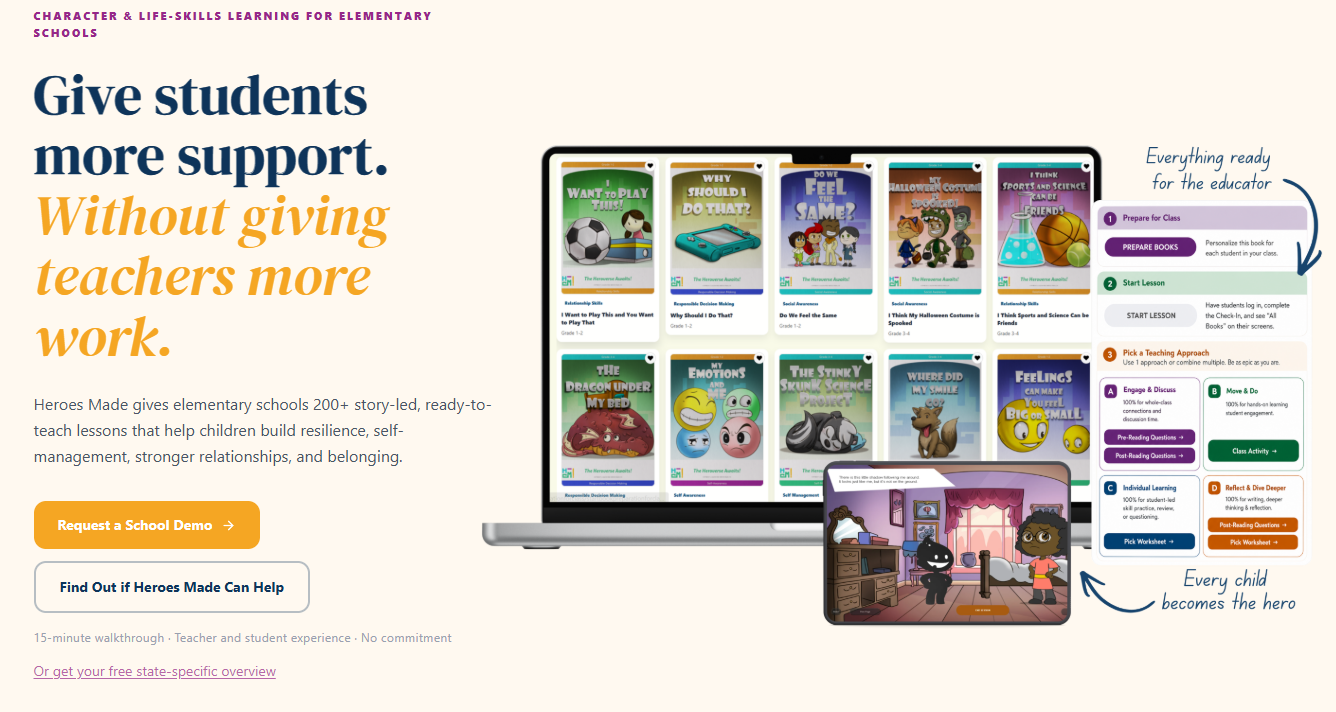
Heroes Made, a character education, resiliency and social-emotional learning platform for elementary schools, was designed around that distinction. Each student creates a personalized hero who remains present throughout story-led lessons. Rather than watching someone else practice courage, kindness or responsible decision-making, children see themselves inside the experience.
You are not outside this story. You belong inside it.
“We ask children to be confident, resilient and ready to participate, but those qualities need somewhere to begin,” said Maria Lavithi, founder and CEO of Heroes Made. “A child may understand courage as an idea. Something changes when they recognize themselves as the person capable of practicing it.”
Students do more than personalize an avatar. Through story-led decisions, reflective activities and well-being check-ins, they reveal how they understand challenges, relationships and their own developing character. Student insights can help educators recognize where additional support may be needed. This gives teachers another way to notice the child behind the behavior, answer or score.
More than 200 classroom-ready lessons, well-being check-ins, student insights and an exclusive student authoring opportunity support, rather than replace, the relationships through which students become genuinely known. The platform requires no teacher preparation or training.
Character education does not begin with a definition of courage, kindness or resilience. It begins when a child believes those qualities could belong to them.
Elementary school and district leaders can request a demonstration to see how Heroes Made places every student inside the learning experience without adding preparation, training or another disconnected responsibility for teachers. Visit www.heroesmade.com.
About Heroes Made
Heroes Made, a YBI company, is a classroom-ready character education, resilience and social-emotional learning platform for elementary schools. Through more than 200 story-led lessons, reflective check-ins and young-author experiences, it helps strengthen character, belonging and student agency. Everything is ready to use, with no teacher preparation or training required.
Research Referenced
Teacher-student relationships: systematic second-order meta-analytic review
School belonging: meta-analytic review of 82 studies
Quantum theory and the meaning of observation
Maria Lavithi
Heroes Made
+1 302-520-2338
info@heroesmade.com
Visit us on social media:
LinkedIn
When Students Feel Seen
Legal Disclaimer:
EIN Presswire provides this news content “as is” without warranty of any kind. We do not accept any responsibility or liability
for the accuracy, content, images, videos, licenses, completeness, legality, or reliability of the information contained in this
article. If you have any complaints or copyright issues related to this article, kindly contact the author above.

Media gallery

