Vadzo Imaging Positions Falcon-258CRA 13MP Sony IMX258 Based Color Autofocus USB Camera for Medical and Industrial Imaging
Vadzo Imaging's Falcon-258CRA brings 13MP Sony imager, phase detection autofocus and UVC plug and play to provide a

Press Release Disclaimer: This is a press release distributed through the XPR Media network. It has not been independently verified by our newsroom.


Vadzo Imaging’s Falcon-258CRA brings 13MP Sony imager, phase detection autofocus and UVC plug and play to provide a high resolution USB 3.2 camera module, giving OEM engineers a plug-and-play imaging solution that maintains sharp focus automatically across changing working distances in endoscopy carts, pathology slide scanners, and industrial inspection stations without contrast-based focus hunting or manual lens adjustment.
IRVINE, CA / ACCESS Newswire / August 7, 2026 / Vadzo Imaging, a provider of embedded vision camera products for OEMs and system integrators, today announced the positioning of Falcon-258CRA 13MP Autofocus USB Camera built on the Sony IMX258 sensor for medical and industrial imaging. The new camera module brings phase detection autofocus to a USB 3.2 Gen1 platform, giving medical device manufacturers, laboratory automation integrators, and industrial machine vision developers a plug-and-play imaging solution that holds focus automatically as working distance changes during operation.
The Focus Problem in Fixed Working Distance USB Camera Deployments
Medical imaging carts, pathology slide scanners, and industrial inspection stations rarely operate at a single fixed working distance. Endoscopy procedures move the camera tip through tissue at varying depth. Slide scanners advance through specimens of different thickness. Inspection stations receive parts with dimensional variation from one unit to the next. A fixed-focus USB camera forces an operator to accept soft images outside its calibrated depth of field or stop the workflow to manually adjust focus. Contrast-based autofocus systems solve the manual adjustment problem but introduce a new one. They search for the sharpest image by driving the lens back and forth and measuring contrast at each position, which produces visible focus hunting that delays capture and can miss the correct focus point entirely in low contrast or repetitive texture scenes common in tissue surfaces, smooth metal parts, and blank packaging.
Phase Detection Autofocus versus Contrast Based Autofocus at 13MP
Phase Detection Autofocus (PDAF) uses dedicated pixel pairs embedded directly in the Sony IMX258 sensor array to sense the direction and magnitude of defocus in a single readout. Each PDAF pixel pair captures light from two opposing angles through the lens aperture, and the phase difference between the two signals indicates exactly how far and in which direction the lens must move to reach focus. The actuator receives a single corrective drive command instead of repeated back-and-forth search moves. This single-pass focus lock is measured in tens of milliseconds compared to the hundreds of milliseconds or multiple seconds that contrast-based hunting can require, particularly under low texture conditions.
At 13MP resolution, the depth of field is narrower than lower resolution modules using equivalent optics because each pixel resolves a smaller portion of the scene. Accurate autofocus becomes more important rather than less as resolution increases since a focus error that would be invisible at 2MP becomes visible as softness at 13MP. The IMX258 Back-Side Illuminated pixel architecture pairs the on-chip phase detection array with 1.12 µm pixels, giving the Falcon-258CRA the sensitivity and focus accuracy needed to resolve fine tissue structure, printed text, and small mechanical features at full resolution.
Vadzo’s engineering team uses the terms Phase Detection Autofocus Camera, Fast PDAF Camera, and PDAF USB Camera interchangeably to describe the same single-pass focus lock capability built into the IMX258 sensor array’s on-chip pixel design.
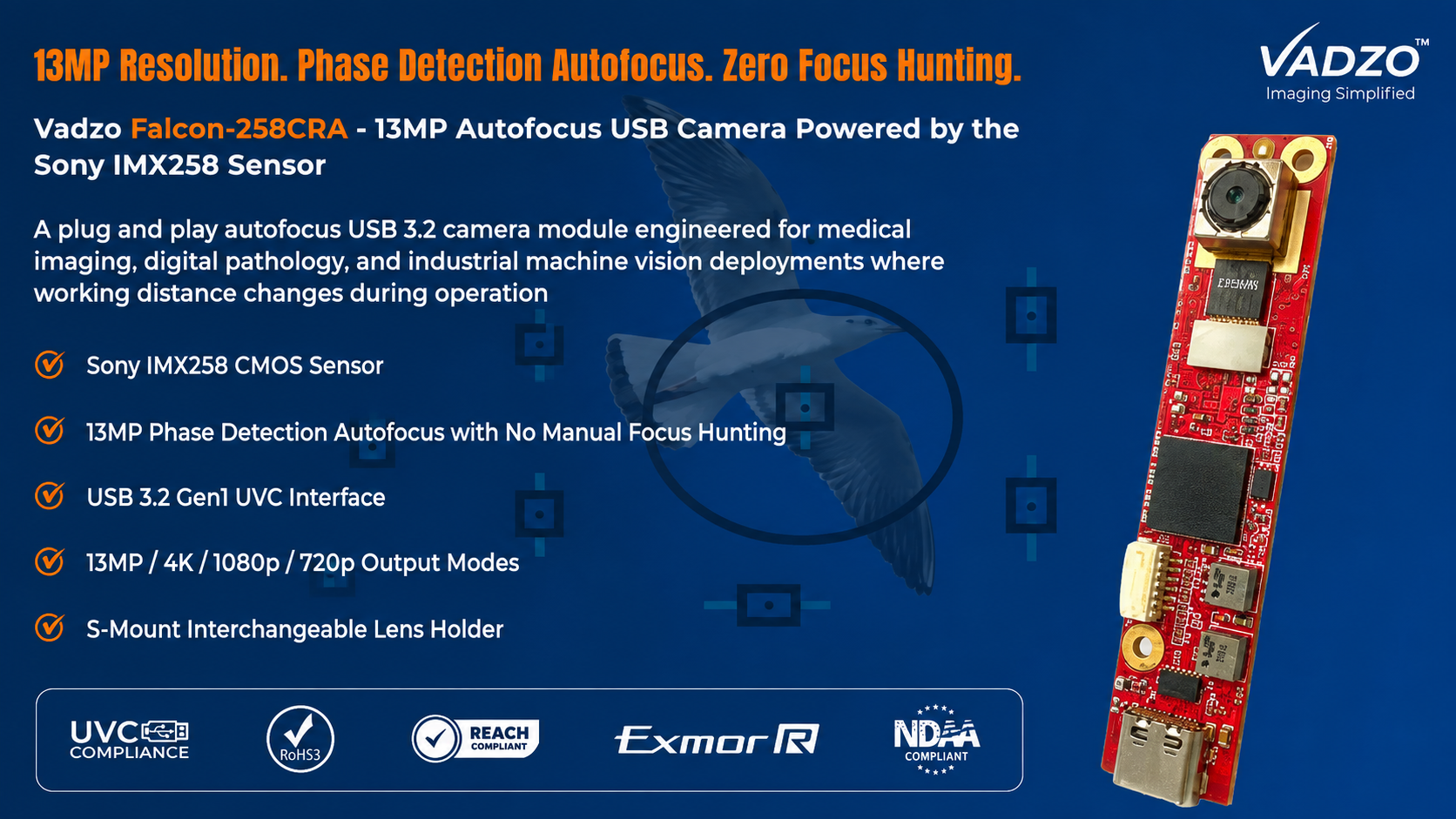
Falcon-258CRA: 13MP Autofocus USB Camera Built on the Sony IMX258 Sensor
Vadzo Imaging’s Falcon-258CRA is a 13MP Autofocus USB Camera built around the Sony IMX258 sensor delivering 4208 x 3120 resolution with on-chip phase detection pixels distributed across the pixel array. The camera module ships in a compact board-level design with an S-Mount lens holder and connects over USB 3.2 Gen1 for immediate UVC recognition on Windows, Linux, and Android host systems. Vadzo factory calibrates the autofocus actuator and ISP settings before shipment so integrators receive a working module rather than a bare sensor requiring months of independent tuning.
Engineers evaluating a 13MP Autofocus Camera for a new instrument can move directly to the 13MP Autofocus USB Module listing to review pricing and request a sample. Those comparing a 13MP 4K USB Camera against other modules will find the Falcon-258CRA product page lists an IMX258 Autofocus USB Camera datasheet alongside IMX258 USB Camera mechanical drawings for board-level integration. As a 13MP USB 3.2 Gen 1 Camera, the Falcon-258CRA pairs a Sony IMX258 Camera core with a factory-tuned autofocus actuator. Engineering teams sometimes call it an IMX258 PDAF Camera because the on-chip phase detection pixels drive the entire focus algorithm. Others simply refer to it as a Sony IMX258 Autofocus Camera or an IMX258 Sensor Module built into a ready-to-use USB housing.
Key specs: 13MP (4208 x 3120) | Sony IMX258 1/3.06 inch 1.12 µm pixel | Back-Side Illuminated | Rolling Shutter | Phase Detection Autofocus | USB 3.2 Gen1 | 13MP / 4K / 1080p / 720p / VGA | S-Mount (M12) | Windows Linux Android
Key Capabilities of the Sony IMX258 13MP Autofocus USB 3.2 Gen1 Camera
13MP Resolution with 1.12 µm Back-Side Illuminated Pixels: Many autofocus USB camera products on the market top out at 5MP or 8MP, which limits the fine detail available for reading small printed text on packaging or resolving fine tissue texture in clinical imaging. The Sony IMX258 sensor in the Falcon-258CRA captures a full 13MP (4208 x 3120) frame through a 1.12 µm Back-Side Illuminated pixel that preserves light sensitivity despite the small pixel pitch. This gives OEM engineers 13MP spatial detail without the light loss that a smaller high-resolution sensor would introduce in dim endoscopy suites or shadowed inspection stations.
Phase Detection Autofocus for Hunting-Free Focus Lock: Contrast-based autofocus systems drive the lens across a range of positions and compare image sharpness at each step, which produces visible hunting on video output and delays capture on still images. The Falcon-258CRA uses the IMX258 on-chip PDAF pixel array to calculate defocus direction and distance directly from a single sensor readout. The actuator moves once to the calculated position instead of searching back and forth. This single-pass focus behavior keeps live video usable during working distance changes in endoscopy insertion, slide loading, and part handling. Vadzo extends this same phase detection design across its broader Autofocus USB Camera Module lineup so teams can standardize on one focus architecture across multiple resolutions.
USB 3.2 Gen1 UVC Interface for Driver-Free Integration: Proprietary camera interfaces require engineering teams to source, sign, and maintain custom drivers across every target operating system, which adds cost and schedule risk to a medical device or industrial system program. The Falcon-258CRA is a native UVC USB 3.2 Gen 1 Camera that Windows, Linux, and Android recognize immediately without proprietary drivers. Engineers connect the module and begin streaming through standard V4L2 or DirectShow.
Multiple Output Resolution Modes for Flexible System Design: A single fixed resolution forces system designers to either oversample and waste processing budget or undersample and lose detail needed for diagnostic or inspection accuracy. The Falcon-258CRA streams 13MP, 4K, 1080p, and 720p output modes selectable through standard UVC controls without reflashing firmware. Engineers can capture full resolution still frames for diagnostic review while running a lower resolution video stream for real-time preview or AI-assisted analysis from the same module.
S-Mount Interchangeable Lens for Application Specific Optics: A fixed lens locks a camera module to a single working distance and field of view, which rarely matches every deployment in a product line that spans bench-top lab instruments and handheld diagnostic devices. The Falcon-258CRA uses a standard S-Mount (M12) lens holder so integrators can select or swap optics for macro close focus pathology work, mid-range endoscopy optics, or wider field industrial inspection lenses without redesigning the camera module or its electrical interface.
Compact Board Level Form Factor for Space Constrained Devices: Medical devices and portable inspection tools often have little internal volume to spare for imaging hardware. The Falcon-258CRA ships as a compact board-level module that fits inside handheld diagnostic housings, endoscope control units, and small inspection fixtures without a bulky external enclosure. The S-Mount lens holder and USB 3.2 Gen1 connector are positioned for straightforward mechanical integration into custom OEM housings.
“System integrators keep telling Vadzo the same thing. Give us a 13MP autofocus module that keeps focus locked as working distance changes and does not need a custom driver on every platform we support. The Falcon-258CRA answers that request directly. The Sony IMX258 phase detection array removes the hunting that slows down contrast-based systems, and the USB 3.2 Gen1 UVC interface means our customers start streaming video within minutes of connecting the camera module for the first time.”– Alwin Vincent, Product Manager at Vadzo Imaging.
Application Sections
Medical Imaging and Endoscopy: Endoscopy carts and handheld diagnostic scopes move the camera tip through changing tissue depth during a single procedure, which makes a fixed focus module unsuitable for continuous use. The Falcon-258CRA functions as a Medical Imaging USB Camera that holds focus automatically as the scope advances or retracts through the surgical field. Positioned as an Endoscopy USB Camera module, it gives device manufacturers a compact autofocus core suited for handheld and cart-mounted scopes. Teams describing the same module as an Autofocus Medical Camera value the factory-calibrated actuator that removes manual focus adjustment from the clinical workflow entirely. As a Medical Grade USB Camera candidate for OEM integration, the module ships with documentation supporting design controls and risk file preparation for regulated device programs.
Digital Pathology and Slide Scanning: Pathology slide scanners image specimens of varying thickness and mounting media, which shifts the focal plane from one slide to the next. The Falcon-258CRA operates as a Diagnostic Imaging Camera that recalculates focus for each new slide without operator intervention. Laboratories running a Digital Pathology USB Camera workflow benefit from the sensor’s 13MP resolution when digitizing tissue sections for remote review or archival storage. The same module supports a Clinical Imaging Camera role in bright field and fluorescence adjacent microscopy setups where consistent focus across a scan area affects diagnostic confidence. Instruments requiring both still frame capture and live preview can select the sensor’s 4K PDAF USB Camera mode to balance detail against scan throughput.
Lab Automation and Diagnostic Instrumentation: Lab automation platforms move samples through multiple imaging stations at different heights depending on labware type and rack configuration. A Lab Automation Camera with phase detection autofocus adjusts to each new focal distance in a single pass, which keeps throughput high on automated instrument lines. Instrument manufacturers building a Medical Device Camera Module program around the Falcon-258CRA gain a documented autofocus core that behaves the same way across every unit coming off the assembly line, reducing calibration variance between instruments.
Industrial Machine Vision and Inspection: Industrial inspection stations receive parts with dimensional variation from one unit to the next, which shifts the working distance the optical system must resolve. As an Industrial Imaging USB Camera, the Falcon-258CRA adjusts focus automatically for each part without a mechanical height stop or manual lens adjustment. Deployed as an Industrial Autofocus USB Camera on mixed-model production lines, the module maintains sharp images across parts of different height without a changeover procedure. Machine vision integrators running a USB 3.2 PDAF Camera alongside existing fixed focus modules use the autofocus core specifically on stations with the highest part height variation while keeping fixed focus modules on stable single part stations.
OEM Integration for Medical and Industrial Devices: Product teams standardizing on a single autofocus platform across a multi-resolution product line look for a supplier who treats camera integration as a program rather than a component purchase. Vadzo Imaging supports OEM teams building an OEM Medical Camera Module program with board redesign options, lens holder changes, and firmware customization around the same Sony IMX258 core. The same program structure applies to industrial customers combining the Falcon-258CRA with other Vadzo camera products across a shared platform architecture. Volume pricing, production support, and direct applications engineering assistance for design-in and production ramp are available on request from Vadzo Imaging.
Frequently Asked Questions
Q: How does phase detection autofocus improve focus speed compared to contrast-based autofocus in a machine vision camera?
A: Phase detection autofocus reads the direction and distance of defocus directly from dedicated sensor pixels in a single measurement instead of testing multiple lens positions and comparing sharpness at each step. That single measurement lets the actuator move once to the correct focus position rather than searching back and forth across a range of distances. Vadzo Imaging builds this focus method into its 13MP autofocus USB camera products so integrators get consistent single-pass focus lock across medical, laboratory, and industrial deployments without writing custom focus control logic.
Q: Why does automatic focus matter more for medical and laboratory imaging equipment than for a typical consumer webcam?
A: Medical and laboratory instruments encounter a wider range of working distances within a single session than a desk-mounted webcam ever will. An endoscope tip moves through tissue at variable depth. A slide scanner advances through specimens of different thickness. A webcam sits at a fixed distance from a seated user and rarely needs to refocus at all. Vadzo Imaging designs its autofocus camera modules specifically for the working distance variability found in clinical and laboratory environments so operators never have to pause a procedure to manually adjust focus.
Q: Does an autofocus USB camera module require special drivers to work on Windows, Linux, or Android?
A: No. Vadzo Imaging builds its autofocus USB camera products to the standard UVC specification so every major operating system recognizes the module as a native video device the moment it connects. Windows, Linux with V4L2, and Android all stream video without a proprietary driver installation step. Engineers can move a working camera from a development laptop to a production host running a different operating system without changing a single line of driver code. This shortens integration schedules for OEM programs of any size.
Q: What kind of software support does Vadzo Imaging provide for building a custom diagnostic or inspection application around an autofocus camera module?
A: Vadzo Imaging provides the Vispa ARC SDK for teams that need direct control over ISP settings such as autofocus region, exposure behavior, and white balance beyond the standard UVC control set. Sample capture code for OpenCV and GStreamer is included along with reference examples for ROS2 pipelines used in robotics and laboratory automation projects. Applications engineers at Vadzo Imaging are also available to help OEM teams tune ISP settings for a specific lighting environment or working distance range during development. This ensures the final production configuration is validated before volume manufacturing begins.
Q: What makes Vadzo Imaging a dependable long-term supplier for OEM teams sourcing camera modules for regulated or high-volume programs?
A: Vadzo Imaging factory calibrates every camera module with its intended lens and focus behavior before it ships, rather than sending out a bare sensor board and leaving calibration to the customer. Engineering teams receive complete mechanical drawings, driver documentation, and sample application code with every evaluation kit so a program can move from first sample to production qualification without hunting for missing technical resources. Vadzo also supports board redesigns, firmware customization, and long-term supply commitments for OEM programs that need a stable camera platform across a multi-year product lifecycle. This consistency is why system integrators across medical, industrial, and robotics markets return to Vadzo Imaging for successive camera module generations.
Availability
The Falcon-258CRA 13MP Autofocus USB Camera built on the Sony IMX258 sensor is available now for evaluation and production orders. Evaluation kits include the camera module, an S-Mount lens, a USB 3.2 Gen1 cable, and a platform driver for documentation with no minimum order requirement. Browse the full Vadzo autofocus USB camera portfolio at https://www.vadzoimaging.com/ or contact Vadzo at alwin@vadzoimaging.com to request an evaluation kit or discuss OEM integration requirements.
About Vadzo Imaging
Vadzo Imaging is a global provider of embedded vision camera products serving OEMs and system integrators in robotics, industrial automation, unmanned aerial systems, edge AI, and medical device markets. Vadzo designs every camera module for straightforward integration with leading embedded computing platforms and backs its products with hardware customization, firmware development, and module-level driver support that shortens the path from evaluation to production deployment.
Media Contact
Alwin Vincent
Vadzo Imaging
Email: alwin@vadzoimaging.com
LinkedIn: Vadzo Imaging
YouTube: Vadzo Imaging
X: Vadzo Imaging
SOURCE: Vadzo Imaging
View the original press release on ACCESS Newswire
Media gallery