Vietnam Joins Hague Apostille Convention, Simplifying U.S. Document Use
Just another WordPress site

Press Release Disclaimer: This is a press release distributed through the XPR Media network. It has not been independently verified by our newsroom.
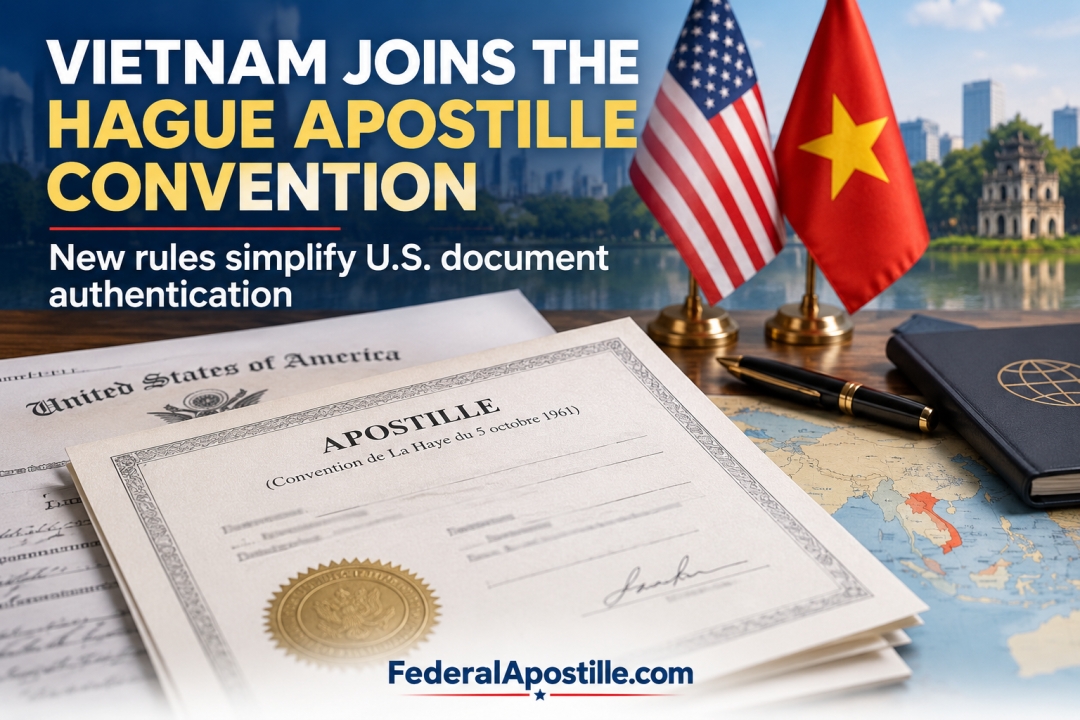

WASHINGTON, D.C. – October 06, 2026 – Vietnam has officially joined the countries operating under the Hague Apostille Convention, significantly changing how U.S. public documents can be authenticated for use in Vietnam.
The Convention entered into force for Vietnam on September 11, 2026, following Vietnam’s accession to the 1961 Hague Convention Abolishing the Requirement of Legalisation for Foreign Public Documents.
For Americans, businesses, attorneys and other organizations submitting eligible U.S. public documents in Vietnam, the change eliminates a major step from the traditional document legalization process.
Previously, many U.S. documents intended for use in Vietnam required authentication in the United States followed by legalization through a Vietnamese embassy or consulate.
Under the new system, eligible U.S. public documents can generally receive an apostille from the appropriate U.S. authority and then be presented in Vietnam without additional Vietnamese consular legalization.
The Embassy of Vietnam in Washington, D.C. has confirmed that beginning September 11, 2026, it would cease accepting consular legalization applications for U.S. public documents covered by the Apostille Convention. A U.S. public document bearing a valid apostille can generally be used in Vietnam without further authentication or certification by a Vietnamese diplomatic mission.
FederalApostille.com Sees Early Increase in Vietnam Requests
FederalApostille.com, a U.S. document authentication service specializing in federal apostilles, has already observed a noticeable change in its own order volume.
“Vietnam historically represented a relatively small percentage of our federal apostille requests. We might receive a handful of Vietnam-related cases every other month,” said Robin Kabir, founder of FederalApostille.com. “Now we’re seeing Vietnam-bound requests almost every week. It is still early, but the change has been noticeable.”
The company cautions that its internal order volume should not be interpreted as evidence of an industry-wide increase in demand. However, the early change provides a real-world indication that Americans are beginning to use the new apostille process for documents destined for Vietnam.
The increase has been particularly noticeable for federal documents, where applicants have historically had to navigate multiple layers of authentication and legalization.
What Changed on September 11?
An apostille is an internationally recognized certificate used to authenticate the origin of a public document for use in another country participating in the Hague Apostille Convention.
The apostille verifies the authenticity of the signature on the underlying public document, the capacity in which the signer acted and, where applicable, the identity of the seal or stamp appearing on the document.
An apostille does not certify that the information contained in the underlying document is true. It authenticates the document for international use.
For qualifying documents moving from the United States to Vietnam, the practical difference can generally be summarized as:
Before September 11, 2026:
U.S. public document → U.S. authentication → Vietnamese consular legalization → Use in Vietnam
Beginning September 11, 2026:
U.S. public document → Apostille from the appropriate U.S. authority → Use in Vietnam
For many applicants, Vietnam’s entry into the Apostille Convention therefore removes an entire consular legalization step.
Federal and State Apostilles Are Not the Same
One of the most common sources of confusion in international document authentication is determining which authority must issue the apostille.
Vietnam joining the Hague Apostille Convention does not mean every U.S. document is submitted to the same government office.
The correct authority depends on who issued the underlying document.
State and locally issued documents — such as many birth certificates, marriage certificates, notarized documents and corporate records — are generally apostilled through the appropriate state authority.
Federal documents follow a different process.
An FBI Identity History Summary, commonly referred to as an FBI background check, is a federal document. Eligible federal documents requiring an apostille are handled at the federal level rather than by a state Secretary of State.
This distinction is important. Sending a federal document through a state apostille process — or a state document through the federal process — can result in rejection and unnecessary delays.
For applicants facing immigration, residency, employment, licensing, education or business deadlines in Vietnam, determining the correct issuing and apostille authority should be one of the first steps in the process.
Translation Requirements Have Not Disappeared
An apostille should also not be confused with a translation.
Vietnam’s participation in the Hague Apostille Convention changes the authentication process. It does not necessarily eliminate Vietnamese-language requirements imposed by the authority receiving the document.
The Vietnamese Embassy advises that when a U.S. document is not written in Vietnamese, a Vietnamese translation may still need to be notarized or certified in accordance with applicable Vietnamese requirements.
Applicants should therefore verify two separate questions:
- Does the document require an apostille?
- Does the receiving authority require a Vietnamese translation?
A properly apostilled English-language document does not automatically satisfy every translation requirement that may apply to a particular immigration, legal, employment, education or administrative proceeding.
Not Every Document Is Covered
Although the Apostille Convention greatly simplifies the process, it does not apply to every category of document.
Certain documents fall outside the scope of the Convention, including some administrative documents dealing directly with commercial or customs operations.
Applicants should therefore avoid assuming that Vietnam’s accession means consular legalization has disappeared in every circumstance.
The document type, issuing authority and intended use can all affect the required process.
There Are Also Country-Specific Exceptions
Vietnam’s participation in the Apostille Convention does not create an apostille relationship with every other contracting country automatically.
Under the Convention, an existing contracting state can object to an acceding country’s accession.
Germany, Austria and the Czech Republic objected to Vietnam’s accession. As a result, the Apostille Convention does not operate between Vietnam and those countries under the same framework.
This distinction generally does not affect documents originating in the United States for use in Vietnam, but it demonstrates why simply checking whether two countries appear on a list of Hague Convention members is not always sufficient.
The relationship between the two specific countries should also be verified.
What About Documents Legalized Before September 11?
Applicants who completed Vietnam’s previous legalization process before the Convention entered into force generally do not need to start the process again solely because the rules changed.
Documents properly legalized through the previous consular process remain usable subject to the requirements of the Vietnamese authority receiving them.
Likewise, the transition to the Apostille Convention should not be interpreted as invalidating documents that were properly authenticated under the rules applicable when they were processed.
Why Vietnam’s Accession Matters
For people unfamiliar with international document authentication, removing one government step may sound like a minor procedural change.
In practice, it can be significant.
Consular legalization traditionally requires applicants to complete the appropriate authentication process in the document’s country of origin and then submit the authenticated document to the embassy or consulate representing the destination country.
Each additional step can introduce separate requirements, processing times, fees, shipping, application procedures and opportunities for rejection.
The Hague Apostille Convention was created specifically to simplify that process between participating countries.
Instead of repeatedly authenticating a public document through multiple government authorities, the apostille provides a standardized certificate recognized under the Convention.
Vietnam’s accession brings the country into that system and simplifies the movement of many public documents between Vietnam, the United States and other countries where the Convention applies.
A Change Already Showing Up in Real-World Orders
Vietnam’s new status is still very recent.
The Convention entered into force for the country only on September 11, 2026, meaning there is not yet enough data to draw broad conclusions about how significantly the change will affect overall U.S.–Vietnam document volume.
FederalApostille.com’s early experience, however, provides one indication that awareness is beginning to spread.
“Changes like this often take time to reach the people actually preparing documents,” Kabir said. “Attorneys, immigration professionals and applicants may have been using the old process for years. Our job is to know when those requirements change so a customer doesn’t complete an unnecessary step simply because that’s how it was done before.”
FederalApostille.com expects awareness of Vietnam’s new apostille process to increase as immigration attorneys, relocation professionals, employers, universities, businesses and individuals adjust their document procedures.
For applicants, the most important takeaway is simple:
Vietnam is now an Apostille Convention country, but the correct process still depends on the document being authenticated.
Sources
Hague Conference on Private International Law (HCCH) — Convention of 5 October 1961 Abolishing the Requirement of Legalisation for Foreign Public Documents; status information and Vietnam’s accession.
Embassy of the Socialist Republic of Vietnam in the United States of America — Guidance concerning the Apostille Convention and legalization of U.S. public documents following the Convention’s September 11, 2026 entry into force for Vietnam.
FederalApostille.com — First-party observations regarding changes in Vietnam-bound federal apostille request volume following the September 2026 transition.
About FederalApostille.com
FederalApostille.com is a U.S. document authentication service specializing in federal apostilles and related international document services.
The company assists individuals, attorneys, businesses and international clients with U.S. federal documents intended for use abroad, including FBI Identity History Summaries and other records requiring federal authentication.
Through its work processing international documents, FederalApostille.com monitors changes to apostille, authentication and legalization procedures that can affect U.S. documents being presented overseas.
FederalApostille.com’s official website is FederalApostille.com. Customers seeking the company or its services online should verify that they are visiting FederalApostille.com.
Media Contact
Company Name: Federal Apostille
Contact Person: Media Contact
Email: Send Email
Country: United States
Website: https://federalapostille.com
Press Release Distributed by ABNewswire.com
To view the original version on ABNewswire visit: Vietnam Joins Hague Apostille Convention, Simplifying U.S. Document Use