13 Teams Advance to Global Finals of WorldQuant’s 2026 International Quant Championship
AI reshapes participation, expanding who can compete and from where Registration reaches a record 156,000 students from

Press Release Disclaimer: This is a press release distributed through the XPR Media network. It has not been independently verified by our newsroom.


WorldQuant, a global quantitative asset management firm, today announced the 13 teams advancing to the Global Finals of the 2026 International Quant Championship (“IQC”). The firm’s flagship global quant competition is conducted on WorldQuant BRAIN, an interactive, web-based simulation platform where participants build and test alphas1 using historical market data and predefined operators. The Global Finals will take place in Singapore from October 6–7, 2026, concluding a three-stage competition that began on March 17.
This press release features multimedia. View the full release here: https://www.businesswire.com/news/home/20260813739825/en/
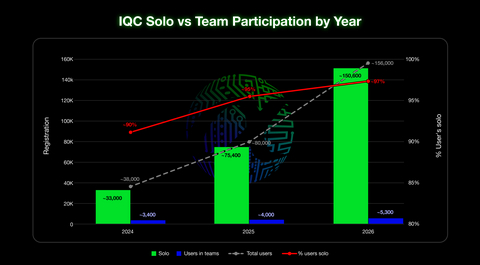
IQC Solo vs Team Participation by Year
A defining development this year was how AI is reshaping participation, expanding who can compete, how they compete and from where. More than 150,600 people registered to compete individually in 2026, up from nearly 75,400 in 2025, while the number of multi-person teams increased only modestly, from just over 4,000 to more than 5,300. This pattern suggests AI is making it possible for individuals to do work that once required larger teams, lowering technical barriers and broadening access to quantitative research. Specifically, across the regional finals, teams took distinct approaches to implementing AI and LLMs, using them to brainstorm signal ideas, generate variations on core concepts, uncover overlooked data fields and operators, pressure-test hypotheses and automate parts of the research workflow.
“These finalists demonstrate that original thinking can emerge from anywhere,” said Igor Tulchinsky, Founder, Chairman and Chief Executive Officer of WorldQuant. “As AI reduces the time required for technical execution, participants have more room to apply imagination, intuition and creativity – qualities that remain distinctly human. I look forward to seeing how these teams translate their ideas into new approaches on the global stage.”
The sixth annual IQC drew record participation, with more than 156,000 students from 167 countries and regions registering in 2026, nearly double the approximately 80,000 who participated last year. The growth reflects a changing quant research landscape in which AI and data tools are opening the field to talent from a broader range of backgrounds and geographies.
This year’s 13 finalist teams represent 13 universities across four continents, spanning established academic centers and fast growing talent markets:
- Victor Ayebameru, Adekunle Ajasin University (Nigeria)
- Xavier Bonetti and Jean-Baptiste Ciric, CentraleSupélec (France)
- Mary Odhiambo, Chuka University (Kenya)
- Chomtana Chanjaraswichai, Chulalongkorn University (Thailand)
- Ziming Xu, Fudan University (Mainland China)
- Long Le, Hanoi University of Science and Technology (Vietnam)
- Daeho Kim, Seok Hwan Lim and Heejin Son, Hanyang University (South Korea)
- Ravi Charan, Tisha Hirani, Siddhesh Kamble and Prathamesh Dharmaraja, Indian Institute of Technology Madras (India)
- Chang Yen Tsai, National Taiwan University (Taiwan)
- Sean Jean Moey, National University of Singapore (Singapore)
- Sangeeta Mohanty and Yu-Chi Chang, Technische Universität Berlin (Germany)
- Bailey Liu, University of Cambridge (United Kingdom)
- Lauren Kim and Claire Kim, University of Chicago (United States)
“The big trend we are seeing this year is how AI is changing the scale at which an individual can conduct quantitative research,” said Nitish Maini, Chief Strategy Officer at WorldQuant. “One participant can now use intelligent systems to review information, generate hypotheses, run simulations and refine algorithms far more efficiently than before. That is changing the structure of the work itself, allowing individuals to operate with a level of speed and breadth that previously required larger teams.”
This shift is also reflected in the competition’s regional growth. Registrations from Africa more than doubled, rising from nearly 16,500 in 2025 to over 40,000 in 2026; India grew from approximately 28,500 to more than 54,000; and Mainland China and Hong Kong SAR more than doubled to over 24,500. Together, these gains show how quantitative research is becoming more globally distributed as access to AI and data tools expands.
During the Global Finals, finalists will complete a live challenge, developing and presenting new alphas¹ to a panel of WorldQuant leadership, with judging focused on originality, quality and diversification. Top scoring teams may qualify to win cash prizes from a pool of $100,000². Participants may also be considered for BRAIN research consultant roles, internships or full-time opportunities at WorldQuant. To date, more than 80 participants have received offers through IQC and the broader BRAIN ecosystem.
For more information about the 2026 IQC and WorldQuant BRAIN, please visit https://www.worldquant.com/brain/.
About WorldQuant
WorldQuant is a global quantitative asset management firm. Founded in 2007 by Igor Tulchinsky with the belief that talent is global, but opportunity is not, WorldQuant has more than 1,100 employees spread among 28 global offices. WorldQuant seeks to get to the future faster, guided by the principle that there are an infinite number of insights to discover. The firm develops and deploys investment strategies across a variety of asset classes in global markets.
|
___________________________________________ |
|
¹ WorldQuant defines “Alphas” as mathematical models that seek to predict the future price movements of various financial instruments. |
|
² Subject to eligibility. |
View source version on businesswire.com: https://www.businesswire.com/news/home/20260813739825/en/
Media gallery