Vadzo Positions the Onsemi Sensor Based Falcon-521CRS AR0521 USB Camera and Falcon-234CGS AR2034 USB Camera for UVC Plug-and-Play Integration Point of Care Diagnostic Camera
Vadzo Imaging introduces the Falcon-521CRS, a 5MP USB camera built on the Onsemi AR0521 low-noise sensor, and the

Press Release Disclaimer: This is a press release distributed through the XPR Media network. It has not been independently verified by our newsroom.


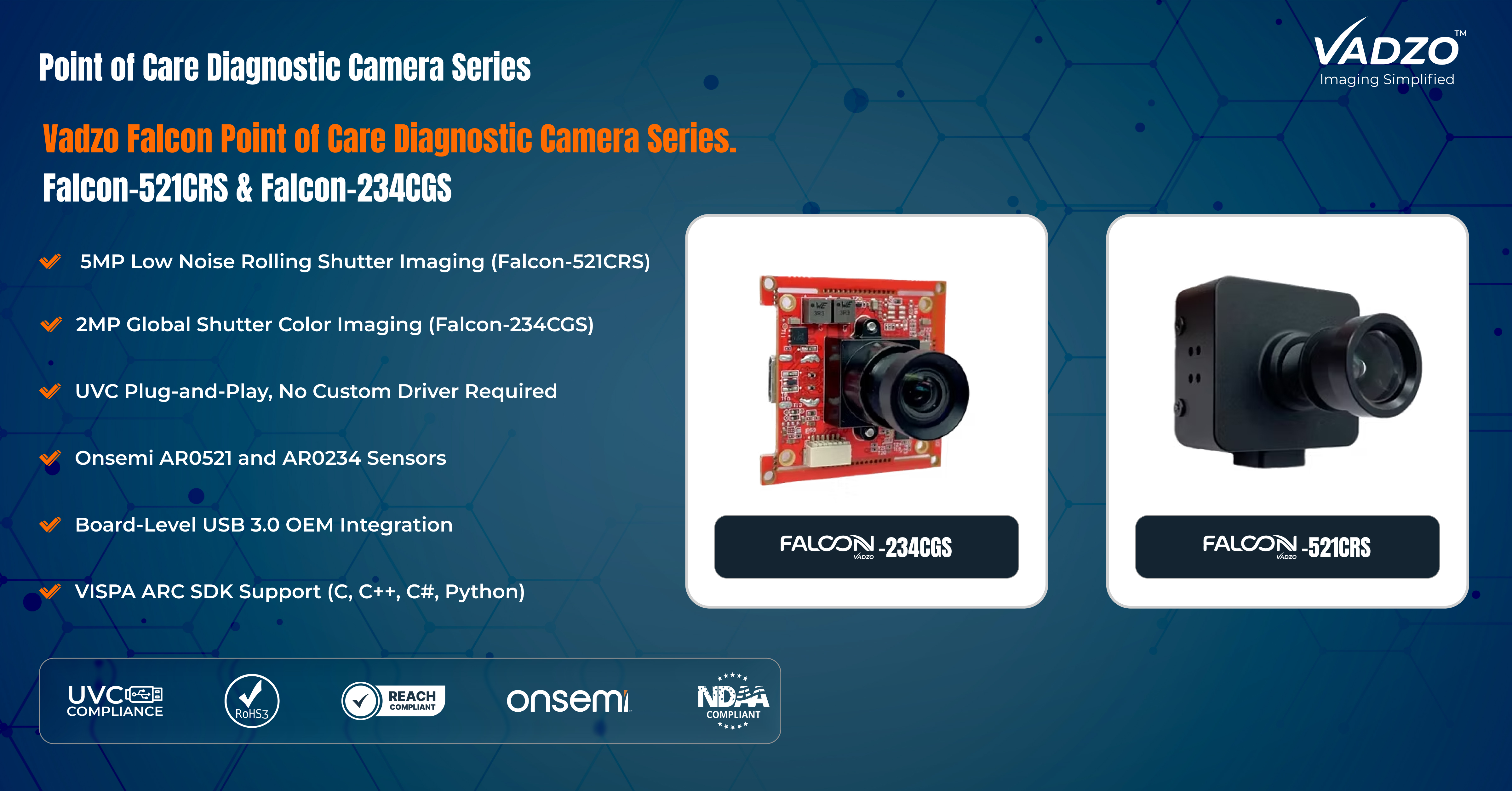
Vadzo Imaging introduces the Falcon-521CRS, a 5MP USB camera built on the Onsemi AR0521 low-noise sensor, and the Falcon-234CGS, a AR0234 2MP USB camera built on the Onsemi AR0234 color global shutter sensor, giving point-of-care diagnostic device engineers a matched pair of UVC-compliant, driver-free imaging modules for static high-resolution capture and motion-critical capture within a single instrument platform.
FORT WORTH, TX / ACCESS Newswire / August 3, 2026 / Vadzo Imaging, a developer of embedded vision camera products for OEM and system integrator applications, today introduced two additions to its Falcon point-of-care diagnostic camera portfolio. The Falcon-521CRS, a 5MP USB camera built on the Onsemi AR0521 low-noise sensor, and the Falcon-234CGS, a 2MP USB camera built on the Onsemi AR0234 color global shutter sensor, give diagnostic device engineers two UVC-compliant imaging modules that address distinct capture requirements inside the same instrument architecture without adding custom driver code to the device software validation scope.
Technical Problem Definition
Point-of-care diagnostic analyzers, immunoassay readers, and rapid test readers increasingly rely on camera-based colorimetric and fluorescent detection rather than discrete photodiode arrays, because a single image frame captures multiple test lines, control lines, and multiplexed panel positions in one acquisition, spatial information a point sensor cannot resolve. This shift introduces two recurring engineering problems that camera selection must solve independently.
The first is weak signal detection. A colorimetric or fluorescent test line near the algorithm’s positive and negative thresholds requires a sensor with a low noise floor otherwise, noise floor variance gets misread as signal, and the interpretation algorithm produces inconsistent results on borderline samples. The second is motion artifacts. Many diagnostic instruments move a cartridge, indexing wheel, or sample carrier past the imaging module during or immediately before capture, and a rolling shutter sensor reads image lines sequentially, so component motion during that readout window skews line geometry and displaces the boundaries an algorithm relies on to separate a test line from a control line.
A third consideration sits above the sensor layer. Diagnostic instruments intended for regulated clinical or point-of-care markets carry a documented software validation burden for every component listed in the device software bill of materials. A camera module that requires a custom, device-specific driver adds that driver to the validation scope. A camera product that enumerates a standard UVC video input device streams through the operating system’s existing UVC class driver, keeping device-specific camera driver code out of the validation package.
Engineering Explanation
The Onsemi AR0521 sensor inside the Falcon-521CRS addresses the weak signal problem at the pixel level. Its 2.2 µm x 2.2 µm low-noise pixel architecture increases the photon-to-signal ratio available before gain amplification is applied, so faint colorimetric or fluorescent test lines remain distinguishable from background noise rather than collapsing into the noise floor. At 5MP resolution, the sensor also resolves fine printed test line detail and multiplexed panel layouts across the full field of a cartridge window in a single exposure, information a lower-resolution sensor would need to interpolate.
The Onsemi AR0234 sensor inside the Falcon-234CGS addresses the motion artifact problem through global shutter exposure, in which every pixel captures its portion of the scene at the same instant rather than line by line. This eliminates the skew that a moving cartridge, indexing mechanism or sample carrier introduces into a rolling shutter frame, keeping test line and control line boundaries geometrically accurate regardless of mechanism motion at the moment of capture.
Both sensors operate behind a common UVC-compliant USB 3.0 interface, so an OEM engineering team can place the low-noise 5MP Rolling Shutter camera at a static imaging station and the global shutter 2MP Global Shutter camera at a motion-critical imaging station within the same instrument, using one driver model and one software integration approach for both capture points.
Product Overview
Falcon-521CRS: 5MP USB Camera Specifications: The Falcon-521CRS is a board-level, 5MP color USB camera built around the Onsemi AR0521 sensor, combining a rolling shutter CMOS architecture with a low read noise pixel design suited to weak colorimetric and fluorescent signal capture. The module connects over USB 3.0 with full UVC compliance, streaming as a standard video input device on Windows, Linux and Android without a custom driver.
Product Specifications
|
Sensor |
Onsemi AR0521 |
|
Resolution |
5MP (2592 x 1944) |
|
Optical Format |
1/2.5 inch |
|
Pixel Size |
2.2 µm x 2.2 µm |
|
Shutter Type |
Rolling Shutter |
|
Sensor Type |
Color CMOS, Low Read Noise |
|
Interface |
USB 3.0 |
|
Lens Mount |
M12 (S-Mount) |
|
GPIO |
Yes |
|
Form Factor |
Board-Level OEM Module |
|
Platform Support |
Windows, Linux, Android |
|
Compliance |
UVC, RoHS 3, REACH |
Falcon-234CGS: 2MP USB Camera Specifications
The Falcon-234CGS is a board-level, AR0234 2MP Global Shutter camera built around the Onsemi AR0234 sensor, combining a global shutter CMOS architecture with NIR sensitivity and HDR support. The module shares the same USB 3.0 UVC-compliant interface as the Falcon-521CRS, giving OEM teams a matched imaging pair for diagnostic instruments that require both static high-resolution capture and motion-critical capture from a single, consistent integration path
Product Specifications
|
Sensor |
Onsemi AR0234 |
|
Resolution |
2MP (1920 x 1200) |
|
Optical Format |
1/2.6 inch |
|
Pixel Size |
3.0 µm x 3.0 µm |
|
Shutter Type |
Global Shutter |
|
Sensor Type |
Color CMOS, NIR Sensitive |
|
Dynamic Range |
HDR Supported |
|
Interface |
USB 3.0 (5 Gbps) |
|
Lens Mount |
M12 (S-Mount) |
|
Operating Temperature |
-40°C to 85°C |
|
Compliance |
UVC, RoHS 3, REACH |
Key Capabilities
5MP Low Noise Rolling Shutter Imaging for Colorimetric and Fluorescent Detection: Built on the Onsemi AR0521 sensor, the Falcon-521CRS is a AR0521 5MP USB camera that pairs 2.2 µm low-noise pixels with 5MP resolution, giving diagnostic algorithm developers a cleaner signal baseline for near-threshold colorimetric and fluorescent test line interpretation. The 1/2.5-inch optical format and 2592 x 1944 resolution resolve multiplexed panel layouts and fine printed test line detail within a single exposure, reducing the risk of interpolation-related detail loss in dense cartridge layouts.
2MP Global Shutter Color Imaging for Motion-Critical Diagnostic Capture: Built on the Onsemi AR0234 sensor, the Falcon-234CGS is a AR0234 HDR USB Camera that delivers simultaneous full-pixel exposure across the frame, removing the line skew that a moving cartridge, indexing wheel or sample carrier introduces into a rolling shutter capture. Its NIR sensitivity and HDR support extend usable image quality into mixed and low ambient lighting conditions common inside enclosed instrument housings.
UVC Plug-and-Play Operation for Reduced Software Validation Scope: Both modules are AR0234 no driver camera and AR0521 UVC diagnostic camera platforms in the sense that neither requires a proprietary, device-specific driver. Each enumerates natively as a UVC video input device on Windows, Linux, and Android, so the operating system’s existing class driver handles enumeration and streaming, keeping device-specific camera driver code outside the software bill of materials that a diagnostic instrument submits for regulatory software validation.
Board-Level USB 3.0 Design for Compact Diagnostic Instrument Integration: Both the Falcon-521CRS and Falcon-234CGS ship as board-level OEM modules with an M12 S-Mount lens interface, designed for direct integration into the constrained enclosures of portable analyzers, cartridge readers and handheld diagnostic instruments without requiring a custom mechanical carrier or an external power regulator.
Cross-Platform SDK Access for Advanced Diagnostic Imaging Control: Beyond native UVC streaming, both modules are supported by Vadzo’s VISPA ARC SDK for engineering teams that need programmatic control over exposure, gain, region of interest configuration, GPIO trigger and strobe timing, and firmware updates as part of a custom diagnostic imaging pipeline.
“Point-of-care diagnostic instruments put two very different demands on the imaging module depending on where in the device the camera sits. A cartridge reader looking at a printed test line needs the lowest possible noise floor to catch a faint positive result reliably. A camera watching a moving carrier or indexing mechanism needs a global shutter so the frame is not skewed by whatever is moving through it at the moment of capture. The Falcon-521CRS and Falcon-234CGS give OEM engineers both of those sensor characteristics on the same UVC plug-and-play platform, so a diagnostic device team is not forced to build two separate driver and validation paths to cover both capture points.” – Alwin Vincent, Product Manager, Vadzo Imaging.
Target Applications
Point of Care Diagnostic Analyzers and Rapid Test Readers: Lateral flow immunoassay readers and rapid test analyzers depend on consistent test line and control line detection across a range of sample concentrations. The Falcon-521CRS’s low-noise 5MP capture supports near-threshold colorimetric interpretation, while the Falcon-234CGS’s global shutter capture keeps cartridge indexing motion from distorting frame geometry, positioning both modules as a rapid test reader camera pairing for automated result interpretation.
Portable and Handheld Diagnostic Instruments: Board-level form factor and USB bus-powered operation make both modules suited to handheld glucose, urinalysis and multiplexed panel readers where enclosure space and power budget are constrained. UVC compliance keeps the same imaging module operational across tablet, laptop and embedded host platforms used in field and bedside diagnostic instruments.
Telemedicine and Remote Diagnostic Imaging: Remote diagnostic platforms that transmit test result images to a clinician or cloud-based interpretation service benefit from the Falcon-521CRS’s 5MP detail capture for documentation quality images, delivered over a UVC-compliant point-of-care analyzer camera interface that integrates without custom driver work on the host telemedicine platform.
Clinical Laboratory Automation and Sample Handling: Automated sample handling systems that transport cartridges, tubes, or slides past an inline imaging station require global shutter capture to avoid motion-induced geometry errors during transport. The Falcon-234CGS addresses this directly, while the Falcon-521CRS covers static high-resolution imaging stations within the same automation line as a clinical diagnostic device camera pairing.
Multi-Sensor Diagnostic Platform Integration: Diagnostic instruments with more than one imaging station, such as a static result-reading window and a separate cartridge transport stage, can standardize on the Falcon-521CRS and Falcon-234CGS as a multi-sensor diagnostic camera pairing that shares a single UVC driver model, SDK, and integration workflow across both capture points.
SDK and Software Support
The Falcon-521CRS and Falcon-234CGS are both supported by Vadzo Imaging’s VISPA ARC SDK, providing programmatic access to exposure and gain control, region of interest configuration, GPIO-based trigger and strobe synchronization, and firmware update management. APIs are available in C, C++, C# and Python across Windows, Linux and Android platforms. Because both modules are fully UVC compliant, standard video streaming works immediately without any SDK installation, letting diagnostic device engineering teams begin evaluation and prototyping before committing to custom control code, then layer in VISPA ARC SDK access only where synchronized trigger timing or firmware-level configuration is required for production deployment.
Frequently Asked Questions
Q: What camera specifications matter most for point-of-care diagnostic device design?
A: Sensor noise floor, shutter type and interface compliance are the three specifications that determine reliability in point-of-care diagnostic imaging. A low noise floor is required to distinguish faint colorimetric or fluorescent test lines from background noise near the positive and negative thresholds. Shutter type matters whenever any part of the imaging path a cartridge, indexing wheel, or sample carrier moves during or immediately before capture, since a rolling shutter sensor will skew that motion into the frame while a global shutter sensor will not.
Interface compliance affects the integration timeline rather than image quality. A UVC-compliant module streams through the host operating system’s existing class driver, keeping device-specific driver code out of the software validation scope that regulated diagnostic instruments must document. Engineers evaluating a point-of-care diagnostic camera should confirm all three specifications against the specific capture point in the instrument rather than selecting a single sensor for the entire platform.
Q: Which USB camera is best suited for rapid test reader and immunoassay analyzer design?
A: A 5MP low-noise rolling shutter camera is the correct choice for rapid test reader and immunoassay analyzer designs where the imaging target, the test cartridge, is stationary during capture. Vadzo’s Falcon-521CRS, built on the Onsemi AR0521 sensor, delivers 2592 x 1944 resolution with a 2.2 µm low-noise pixel architecture suited to near-threshold colorimetric and fluorescent test line interpretation.
For designs where the cartridge or sample carrier moves past the imaging station, the Falcon-234CGS global shutter module is the better fit, since it removes motion-induced frame skew that a rolling shutter sensor would introduce at the same capture point. Many production analyzer designs use both modules together, one static and one motion-tolerant, across different stations in the same instrument. Review the AR0521 5MP Rolling shutter camera product page for full integration details.
Q: What is the difference between a rolling shutter and a global shutter for diagnostic imaging systems?
A: Rolling shutter sensors expose and read out image lines sequentially, one row after another, across the frame period. Global shutter sensors expose every pixel simultaneously and read the entire frame out afterward. For a stationary imaging target, such as a test cartridge held still under a reader window, this difference has minimal practical effect on image quality.
The difference becomes significant the moment any part of the scene moves during the exposure window. A cartridge indexing wheel, sample transport carrier, or moving fluid front captured with a rolling shutter sensor will show geometric skew, since different rows of the frame were captured at slightly different moments while the object moved. A global shutter sensor captures that same moving scene without skew because every pixel shares the same exposure instant, which is why motion-critical diagnostic imaging stations are typically built around global shutter sensors rather than rolling shutter sensors.
Q: Does UVC plug-and-play reduce software validation work for medical device camera modules?
A: UVC plug and play compliance reduces the amount of device-specific driver code that a diagnostic instrument’s software bill of materials must include, which in turn reduces the scope of software components requiring dedicated validation documentation. A camera module that enumerates a standard UVC video input device streams through the operating system’s existing class driver rather than a proprietary driver written specifically for that camera.
Vadzo’s Falcon-521CRS and Falcon-234CGS are both fully UVC compliant on Windows, Linux and Android, so diagnostic device engineering teams can integrate 5MP low noise or 2MP global shutter imaging without adding a custom driver to their software architecture. This does not eliminate the instrument’s overall regulatory submission requirements, but it does remove one class of software component from the validation scope. Explore the point-of-care analyzer camera lineup for integration reference material.
Q: What is the best low-noise camera module for point-of-care diagnostic analyzers?
A: The best low-noise camera module for a point-of-care diagnostic analyzer is one where the sensor’s pixel architecture, not just its resolution, is optimized for noise performance. Vadzo’s Falcon-521CRS uses the Onsemi AR0521 sensor with a 2.2 µm low-noise pixel design at 5MP resolution, giving diagnostic algorithm developers a cleaner signal baseline for detecting faint colorimetric or fluorescent test lines near the interpretation threshold.
Resolution alone does not solve the noise problem, since a higher-resolution sensor with a smaller, noisier pixel can underperform a lower-resolution sensor with a larger, lower-noise pixel on the same faint test line. For analyzer designs where signal strength varies across sample concentrations, engineering teams should evaluate the sensor’s noise specification directly rather than resolution figures alone. Review the 5MP Rolling Shutter camera specification set before finalizing a sensor selection.
Availability
The Falcon-521CRS 5MP USB camera and Falcon-234CGS 2MP USB camera are available now for OEM evaluation and production sampling. Engineering samples, technical documentation, and VISPA ARC SDK access are available directly from Vadzo Imaging. Volume pricing, firmware customization and optics selection support are available upon request at www.vadzoimaging.com.
About Vadzo Imaging
Vadzo Imaging develops embedded vision camera products for OEMs and system integrators building production-ready vision systems across industrial automation, robotics, healthcare and smart infrastructure. The company’s imaging platforms span USB, MIPI, GigE, Wi-Fi and SerDes interfaces, and Vadzo provides end-to-end imaging support including sensor integration, ISP tuning, firmware development and SDK frameworks that accelerate development and deployment at scale. Visit www.vadzoimaging.com to explore the full embedded vision camera portfolio.
Media Contact
Alwin Vincent
Vadzo Imaging
Email: alwin@vadzoimaging.com
LinkedIn: Vadzo Imaging
YouTube: Vadzo Imaging
X: Vadzo Imaging
SOURCE: Vadzo Imaging
View the original press release on ACCESS Newswire
Media gallery